
There's a moment every October when you leave work, step outside and realise it's already dark. For anyone who commutes by e-bike, that's the cue to sort your lights, check your brakes and rethink your route. The clocks go back on Sunday 25 October, and by December the sun can set before 4pm in southern England, and earlier the further north you are.
Riding in the dark isn't scary once you're set up properly. It's actually one of the nicest parts of e-bike life: quiet lanes, cold air, and a motor that makes the ride home feel effortless. Here's how to do it safely and legally.
Quick answer: what lights does an e-bike need by law in the UK?
Between sunset and sunrise, a legal e-bike (an EAPC) is treated like a normal bicycle. It must have a white front light and a red rear light, both lit and working, plus a red rear reflector and amber pedal reflectors. Lights you can see are the minimum. Lights that help you see are what keep you safe.
The legal basics, in plain English
-
Front: a white light, switched on.
-
Rear: a red light, switched on, plus a red reflector.
-
Pedals: amber reflectors (front and rear of each pedal).
-
Condition: lights must work and be properly fitted. A dead battery doesn't count.
Flashing lights are permitted in the UK, but on unlit roads many riders prefer a steady beam up front because it's easier for other road users to judge your distance. If you can, run a steady front light and a flashing rear one.
How bright should your e-bike lights be?
As a rough guide:
-
Lit streets and cycle lanes: around 100 to 200 lumens at the front is enough to be seen.
-
Unlit lanes and paths: aim for 400 lumens or more so you can see the road surface, potholes and wet leaves.
-
Rear: a bright red light you can see from a long way back. Fitting two, one on the bike and one on your helmet or bag, is a cheap safety win.
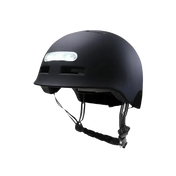
Our helmet with a front light is a handy extra: it puts light where you're looking, and helps drivers spot you at junctions.
Eight habits that make night riding safer
-
Charge your lights, not just your battery. Make it part of the same routine.
-
Wear something reflective. A reflective jacket or ankle bands make you visible from the side, where lights don't reach.
-
Take a proper road position. Don't hug the gutter. Riding a little further out makes you easier to see and keeps you away from drains and debris.
-
Slow down for the wet. Fallen leaves, painted road markings and metal covers get slippery. Brake early and gently.
-
Check your brakes before the dark season starts. Pads wear faster in grit and rain. If they feel soft or noisy, get them looked at.
-
Fit mudguards. Spray from the wheels soaks you and dirties your lights.
-
Choose lit, busier routes. The shortest way home isn't always the safest in November.
-
Plan for the cold. Low temperatures reduce range, so leave a bit of buffer. We've covered that in detail in our guide on e-bike battery performance in cold weather.
Should you use your e-bike's motor in the dark?
Yes, but sensibly. Pedal assist helps you keep a steady pace uphill and pull away at junctions, which is exactly when you want to be moving smoothly rather than wobbling. In wet or icy conditions, choose a lower assist level so the bike doesn't surge when you push hard on the pedals.
What to check on your e-bike before winter
-
Tyres: tread depth and pressure. Slightly lower pressure can add grip in the wet, within the limits printed on the sidewall.
-
Brakes: pad thickness and lever feel.
-
Chain: clean and lightly lubricated.
-
Battery contacts: dry and free of grit.
-
Lights and reflectors: working, secure and charged.
Frequently asked questions
Do I need lights on my e-bike during the day?
Not by law in full daylight, but in poor visibility such as heavy rain or fog, using them is smart.
Can I be fined for riding an e-bike without lights at night?
Yes. Riding without the required lights after dark is an offence, and it also puts you at risk.
Do e-bikes have built-in lights?
Some do, but it varies by model. Check the specification of the bike you're considering, and add a good set if needed.
Is it safe to ride an e-bike in winter?
Yes, with the right preparation: lights, reflective clothing, good tyres, working brakes and a sensible pace.
Related reading
More guides for the colder, darker months and for everyday commuting:
-
What Causes E-Bike Battery Degradation in Cold Weather and How Can Range Be Preserved?
-
Folding Electric Bike vs Standard E-Bike: Which Is Best for Your UK Commute?
Get winter-ready with E Movement
Not sure your bike is ready for the dark months? Our UK-based team can help with servicing, brakes, tyres and the right accessories. Call 01483 363153 or email move@emovement.co.uk.
Book your winter service | Shop helmets and accessories | Browse e-bikes